Dhakma White Paper
The True Cost of Cloud AI
A decision-maker's guide to 5-10x productivity without the security risk, the recurring bills, or the data exposure.

Scroll to read ↓
The question is not whether to adopt AI. It is whether the way you adopt it will expose your clients, your firm, and your competitive advantage to risks you cannot see, cannot audit, and cannot control.
Every month, your team sends thousands of queries to cloud AI providers. Client names. Financial figures. Legal strategies. Medical records. Trade secrets. Each query is processed on infrastructure you do not own, in data centers you cannot inspect, under terms of service that change without notice.
This white paper makes two arguments:
The alternative exists. On-premise AI delivers the same productivity gains with zero cloud exposure, zero recurring per-seat fees, and complete data sovereignty. The economics favor ownership. The security demands it.
Subscribe to the Dhakma Newsletter to continue reading. One email per week. Unsubscribe anytime.
AI vendors price per seat, per month. It looks manageable in isolation. But professional teams do not use one tool. They stack them. And the bill compounds.
| Service | Per Seat / Month | 20 Users / Month | Annual |
|---|---|---|---|
| ChatGPT Enterprise | $60 | $1,200 | $14,400 |
| Microsoft 365 Copilot | $30 | $600 | $7,200 |
| GitHub Copilot Business | $39 | $780 | $9,360 |
| API Costs (custom integrations) | varies | ~$2,000 | $24,000 |
| Compliance overhead (audits, DPA review) | - | - | $5,000-15,000 |
| Total annual cloud AI spend | $60,000-$70,000 | ||
That is $60,000 to $70,000 per year. For a 20-person team. Not a large enterprise. A law firm, a medical practice, a CPA office.
Cloud AI pricing increases annually. OpenAI raised enterprise pricing twice in 2025. Microsoft increased Copilot pricing by 40% between launch and general availability. API token costs fluctuate with demand. Budget predictability is an illusion.
Every new hire adds another seat to every AI subscription. Cloud AI costs scale linearly with headcount. On-premise AI costs stay flat. Hire your 21st employee and the server does not send you an invoice.
Professional service firms bill for time. Every dollar spent on cloud AI subscriptions is a dollar that does not convert to billable revenue. It is overhead that grows every year, controlled by vendors who set the price.
In February 2026, Anthropic confirmed that state-linked Chinese AI laboratories extracted 16 million queries from Claude through 24,000 fraudulent accounts. The operation ran undetected for months. The breach vector was not a firewall exploit. It was the cloud connection itself.
16 million extractions. 24,000 fraudulent accounts. Months of undetected operation. The target was a leading AI provider with world-class security. The vector was structural: cloud-connected infrastructure is, by definition, network-accessible infrastructure.

This was not a theoretical risk assessment. This happened. To one of the most security-conscious AI companies in the world.
Every prompt sent to a cloud AI provider follows the same path:
Cloud AI providers maintain different policies on data retention, model training, and government access requests. These policies change. They are buried in terms of service documents that update quarterly. Your legal team may have reviewed the original agreement. They almost certainly have not reviewed the latest revision.
When your team queries a cloud AI about a client matter, a competitive strategy, or a financial projection, that data enters a system shared with millions of other users. Even if the provider does not intentionally train on your data, the structural risk remains: your most sensitive information is stored on infrastructure that is a high-value target for nation-state actors, corporate espionage, and criminal organizations.
The breach vector is not your firewall. It is the cloud connection your AI vendor maintains on your behalf. Without your knowledge. Without your control.
| Regulation | Applies To | Penalty for Data Exposure |
|---|---|---|
| HIPAA | Medical practices | $100 - $50,000 per violation, up to $1.5M/year |
| Attorney-Client Privilege | Law firms | Bar complaints, malpractice liability, case dismissal |
| CMMC Level 2+ | Defense contractors | Loss of contract eligibility |
| SOX / SEC Rules | Financial firms | Personal liability for officers, fines, sanctions |
| IRS Circular 230 | CPA firms | Censure, suspension, or disbarment from IRS practice |
The common thread: every regulation above assumes you control where client data resides. Cloud AI breaks that assumption. The data leaves your building the moment someone types a prompt.
Your security policy is only as strong as your least trained employee.
A first-year associate pastes a client's financial statement into ChatGPT to draft a summary. A medical assistant uploads patient intake notes to get help with a referral letter. A new hire at an accounting firm asks an AI chatbot to review a client's tax return.
None of them intended to cause a data breach. All of them just did.
Samsung banned employee use of ChatGPT in 2023 after engineers accidentally uploaded proprietary source code, internal meeting notes, and hardware test data in three separate incidents within 20 days. The data entered OpenAI's training pipeline. It cannot be recalled.
Training and policies help. They do not solve the problem. The problem is that cloud AI tools make it trivially easy to upload sensitive information to a third-party server. One click. One paste. One drag-and-drop. The data is gone.
You can write policies. You can train employees quarterly. You can require approval workflows. But every layer of friction you add to cloud AI usage reduces the productivity gains that made AI valuable in the first place.
The more restrictions you place on cloud AI to protect sensitive data, the less productive your team becomes. The more freedom you give them to be productive, the more data you expose. Cloud AI forces you to choose between security and productivity. On-premise AI eliminates the trade-off entirely.
When your team uses cloud AI, every query is a data point. Client names. Deal structures. Legal strategies. Pricing models. Research directions. Competitive positioning.
Cloud AI providers process queries from your competitors on the same infrastructure. The same models. The same data centers. Even without direct data leakage, the aggregate pattern of your queries, the topics, the industries, the urgency, contributes to a profile of your organization's activities that exists on hardware you do not own.
Your trade secrets are not secret if they live on someone else's server.
On-premise AI is not a compromise. It is the same capability, running on hardware you own, in a room you control, with a network cable you can physically disconnect.
A private AI server sits in your office. It runs the same class of large language models available through cloud providers. Your team accesses it through a web interface that looks and feels identical to the cloud tools they already use. The difference is invisible to the end user and absolute at the infrastructure level:
Your team gets the same 5-10x productivity. Your clients get the same quality of work. The only thing that changes is where the computation happens. It happens in your office. Not in someone else's data center.
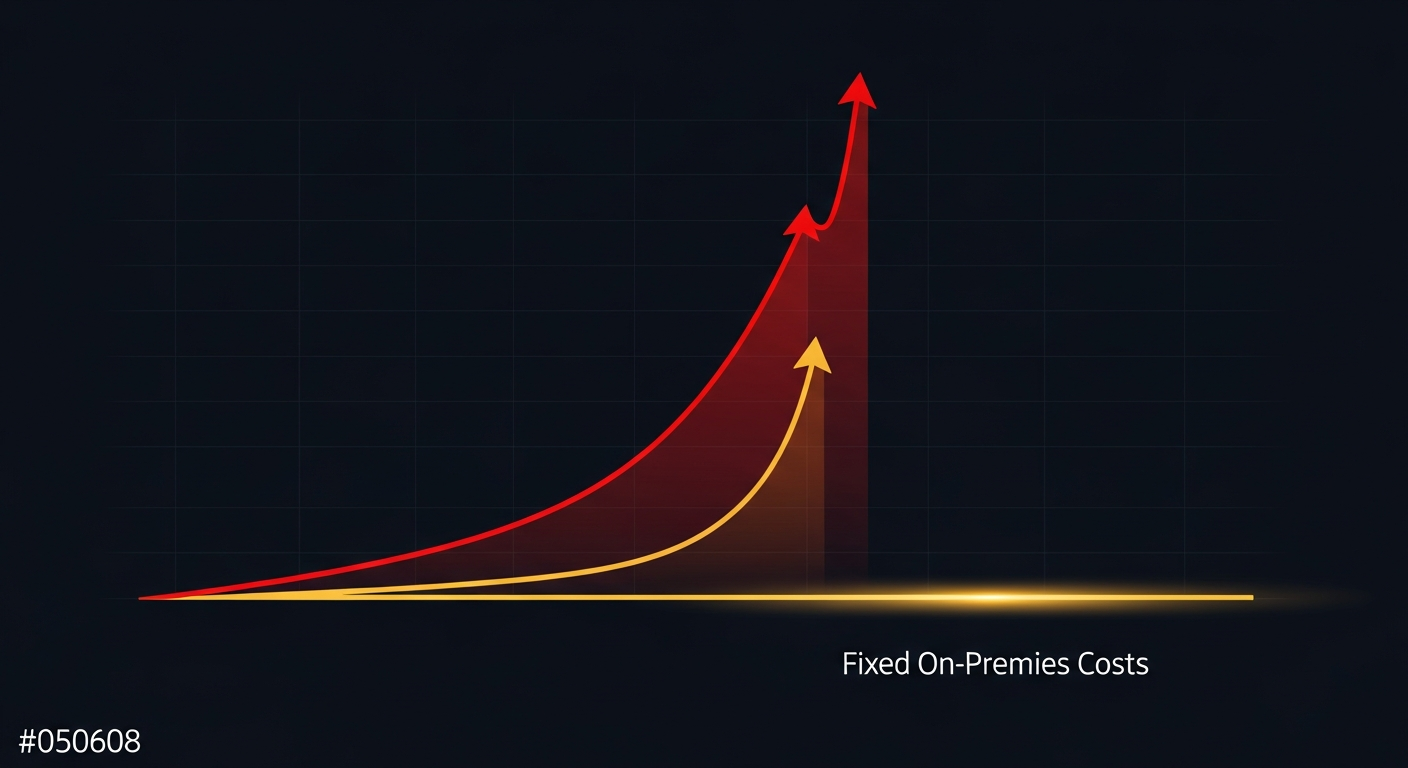
The financial case for private AI is straightforward. Cloud AI is a recurring expense that scales with headcount. On-premise AI is a capital investment that pays for itself.
| Cloud AI | On-Premise AI | |
|---|---|---|
| Year 1 | $65,000 | $35,000 (hardware, software, deployment)* |
| Year 2 | $71,500 (+10% price increase) | $10,000 (maintenance + support) |
| Year 3 | $78,650 (+10% price increase) | $10,000 (maintenance + support) |
| 3-Year Total | $215,150 | $55,000 |
| 3-Year Savings | $160,150 saved — plus unlimited usage, zero breach risk, and you own the hardware | |
| Cloud AI | On-Premise AI | |
|---|---|---|
| Year 1 | $140,000 | $65,000 (hardware, software, deployment)* |
| Year 2 | $154,000 | $10,000 (maintenance + support) |
| Year 3 | $169,400 | $10,000 (maintenance + support) |
| 3-Year Total | $463,400 | $85,000 |
| 3-Year Savings | $378,400 saved — plus unlimited usage, zero breach risk, and you own the hardware | |
*Dhakma Core starts at $35,000 (hardware, software, deployment, training). Year 2+ maintenance is $10,000/year. See full pricing details.
Cloud AI costs scale with headcount and usage. Every new hire adds another seat. Every additional query adds to your token bill. On-premise AI costs are fixed. Your 21st employee does not trigger a new invoice. Your 10,000th query costs the same as your first. And at the end of three years, you own the hardware.
Deploying on-premise AI is not a multi-year IT project. With the right partner, it is a 30-day engagement from initial scoping to full operational capability.
| Week | Phase | Activity |
|---|---|---|
| 1 | Discovery | On-site assessment. Inventory of current AI usage, document workflows, compliance requirements, and network architecture. Hardware specification based on team size and workload profile. |
| 2 | Build | Hardware assembly and configuration. Model selection and loading. RAG engine initialization with client document corpus. Web UI deployment and branding. |
| 3 | Deploy | On-site installation. Network integration (or air-gap configuration). Staff training. Workflow migration from cloud AI tools to the local interface. |
| 4 | Validate | Parallel operation with cloud tools. Performance benchmarking. User feedback collection. Fine-tuning of models and RAG retrieval quality. Cloud AI subscription cancellation. |
At the end of week four, your team is running on private AI. The cloud subscriptions are cancelled. The data stays in the building. The productivity remains.
Private AI is not static. As your team uses the system, it learns your firm's language, your document formats, your workflows. Queries improve. Retrieval accuracy increases. The model becomes more valuable over time, trained exclusively on your data, optimized exclusively for your operations.
The competitive advantage compounds. Every query refines the system. Every document indexed deepens institutional knowledge. After six months, your private AI understands your practice better than any cloud tool ever could. And none of that intelligence has ever left your building.
Subscribe for weekly intelligence on private AI. Or talk to a Dhakma engineer about your deployment.

Dhakma builds private AI infrastructure for professional service firms. On-premise. Air-gapped. Zero cloud.
dhakma.ai · mackie@dhakma.ai · West Lafayette, Indiana